Sunday, April 16, 2017

मुंशी प्रेमचंद

मुंशी प्रेमचंद (अंग्रेज़ी: Munshi Premchand, जन्म: 31 जुलाई, 1880 - मृत्यु: 8 अक्टूबर, 1936) भारत के उपन्यास सम्राट माने जाते हैं जिनके युग का विस्तार सन् 1880 से 1936 तक है। यह कालखण्ड भारत के इतिहास में बहुत महत्त्व का है। इस युग में भारत का स्वतंत्रता-संग्राम नई मंज़िलों से गुज़रा। प्रेमचंद का वास्तविक नाम धनपत राय श्रीवास्तव था। वे एक सफल लेखक, देशभक्त नागरिक, कुशल वक्ता, ज़िम्मेदार संपादक और संवेदनशील रचनाकार थे। बीसवीं शती के पूर्वार्द्ध में जब हिन्दी में काम करने की तकनीकी सुविधाएँ नहीं थीं फिर भी इतना काम करने वाला लेखक उनके सिवा कोई दूसरा नहीं हुआ।[1]
जन्म
प्रेमचंद का जन्म वाराणसी से लगभग चार मील दूर, लमही नाम के गाँव में 31 जुलाई, 1880 को हुआ। प्रेमचंद के पिताजी मुंशी अजायब लाल और माता आनन्दी देवी थीं। प्रेमचंद का बचपन गाँव में बीता था। वे नटखट और खिलाड़ी बालक थे और खेतों से शाक-सब्ज़ी और पेड़ों से फल चुराने में दक्ष थे। उन्हें मिठाई का बड़ा शौक़ था और विशेष रूप से गुड़ से उन्हें बहुत प्रेम था। बचपन में उनकी शिक्षा-दीक्षा लमही में हुई और एक मौलवी साहब से उन्होंने उर्दू और फ़ारसी पढ़ना सीखा। एक रुपया चुराने पर ‘बचपन’ में उन पर बुरी तरह मार पड़ी थी। उनकी कहानी, ‘कज़ाकी’, उनकी अपनी बाल-स्मृतियों पर आधारित है। कज़ाकी डाक-विभाग का हरकारा था और बड़ी लम्बी-लम्बी यात्राएँ करता था। वह बालक प्रेमचंद के लिए सदैव अपने साथ कुछ सौगात लाता था। कहानी में वह बच्चे के लिये हिरन का छौना लाता है और डाकघर में देरी से पहुँचने के कारण नौकरी से अलग कर दिया जाता है। हिरन के बच्चे के पीछे दौड़ते-दौड़ते वह अति विलम्ब से डाक घर लौटा था। कज़ाकी का व्यक्तित्व अतिशय मानवीयता में डूबा है। वह शालीनता और आत्मसम्मान का पुतला है, किन्तु मानवीय करुणा से उसका हृदय भरा है।
पारिवारिक जीवन
प्रेमचंद का कुल दरिद्र कायस्थों का था, जिनके पास क़रीब छ: बीघे ज़मीन थी और जिनका परिवार बड़ा था। प्रेमचंद के पितामह, मुंशी गुरुसहाय लाल, पटवारी थे। उनके पिता, मुंशी अजायब लाल, डाकमुंशी थे और उनका वेतन लगभग पच्चीस रुपये मासिक था। उनकी माँ, आनन्द देवी, सुन्दर सुशील और सुघड़ महिला थीं। छ: महीने की बीमारी के बाद प्रेमचंद की माँ की मृत्यु हो गई। तब वे आठवीं कक्षा में पढ़ रहे थे। दो वर्ष के बाद उनके पिता ने फिर विवाह कर लिया और उनके जीवन में विमाता का अवतरण हुआ। प्रेमचंद के इतिहास में विमाता के अनेक वर्णन हैं। यह स्पष्ट है कि प्रेमचंद के जीवन में माँ के अभाव की पूर्ति विमाता द्वारा न हो सकी थी।
विवाह
जब प्रेमचंद पंद्रह वर्ष के थे, उनका विवाह हो गया। वह विवाह उनके सौतेले नाना ने तय किया था। उस काल के विवरण से लगता है कि लड़की न तो देखने में सुंदर थी, न वह स्वभाव से शीलवती थी। वह झगड़ालू भी थी। प्रेमचंद के कोमल मन का कल्पना-भवन मानो नींव रखते-रखते ही ढह गया। प्रेमचंद का यह पहला विवाह था। इस विवाह का टूटना आश्चर्य न था। प्रेमचंद की पत्नी के लिए यह विवाह एक दु:खद घटना रहा होगा। जीवन पर्यन्त यह उनका अभिशाप बन गया। इस सब का दोष भारत की परम्पराग्रस्त विवाह-प्रणाली पर है, जिसके कारण यह व्यवस्था आवश्यकता से भी अधिक जुए का खेल बन जाती है। प्रेमचंद ने निश्चय किया कि अपना दूसरा विवाह वे किसी विधवा कन्या से करेंगे। यह निश्चय उनके उच्च विचारों और आदर्शों के ही अनुरूप था।
प्रेमचन्द का दूसरा विवाह
पत्नी शिवरानी के साथ प्रेमचंद
सन 1905 के अन्तिम दिनों में आपने शिवरानी देवी से शादी कर ली। शिवरानी देवी बाल-विधवा थीं। उनके पिता फ़तेहपुर के पास के इलाक़े में एक साहसी ज़मीदार थे और शिवरानी जी के पुनर्विवाह के लिए उत्सुक थे। सन् 1916 के आदिम युग में ऐसे विचार-मात्र की साहसिकता का अनुमान किया जा सकता है। यह कहा जा सकता है कि दूसरी शादी के पश्चात् इनके जीवन में परिस्थितियाँ कुछ बदली और आय की आर्थिक तंगी कम हुई। इनके लेखन में अधिक सजगता आई। प्रेमचन्द की पदोन्नति हुई तथा यह स्कूलों के डिप्टी इन्सपेक्टर बना दिये गए।
इसी खुशहाली के जमाने में प्रेमचन्द की पाँच कहानियों का संग्रह सोजे वतन प्रकाश में आया। यह संग्रह काफ़ी मशहूर हुआ। शिवरानी जी की पुस्तक ‘प्रेमचंद-घर में’, प्रेमचंद के घरेलू जीवन का सजीव और अंतरंग चित्र प्रस्तुत करती है। प्रेमचंद अपने पिता की तरह पेचिश के शिकार थे और निरंतर पेट की व्याधियों से पीड़ित रहते थे। प्रेमचंद स्वभाव से सरल, आदर्शवादी व्यक्ति थे। वे सभी का विश्वास करते थे, किन्तु निरंतर उन्हें धोखा खाना पड़ा। उन्होंने अनेक लोगों को धन-राशि कर्ज़ दी, किन्तु बहुधा यह धन लौटा ही नहीं। शिवरानी देवी की दृष्टि कुछ अधिक सांसारिक और व्यवहार-कुशल थी। वे निरंतर प्रेमचंद की उदार-हृदयता पर ताने कसती थीं, क्योंकि अनेक बार कुपात्र ने ही इस उदारता का लाभ उठाया। प्रेमचंद स्वयं सम्पन्न न थे और अपनी उदारता के कारण अर्थ-संकट में फंस जाते थे। ‘ढपोरशंख’ शीर्षक कहानी में प्रेमचंद एक कपटी साहित्यिक द्वारा अपने ठगे जाने की मार्मिक कथा कहते हैं।
शिक्षा
ग़रीबी से लड़ते हुए प्रेमचन्द ने अपनी पढ़ाई मैट्रिक तक पहुँचाई। जीवन के आरंभ में ही इनको गाँव से दूर वाराणसी पढ़ने के लिए नंगे पाँव जाना पड़ता था। इसी बीच में इनके पिता का देहान्त हो गया। प्रेमचन्द को पढ़ने का शौक़ था, आगे चलकर यह वकील बनना चाहते थे, मगर ग़रीबी ने इन्हें तोड़ दिया। प्रेमचन्द ने स्कूल आने-जाने के झंझट से बचने के लिए एक वकील साहब के यहाँ ट्यूशन पकड़ लिया और उसी के घर में एक कमरा लेकर रहने लगे। इनको ट्यूशन का पाँच रुपया मिलता था। पाँच रुपये में से तीन रुपये घर वालों को और दो रुपये से प्रेमचन्द अपनी ज़िन्दगी की गाड़ी को आगे बढ़ाते रहे। प्रेमचन्द महीना भर तंगी और अभाव का जीवन बिताते थे। इन्हीं जीवन की प्रतिकूल परिस्थितियों में प्रेमचन्द ने मैट्रिक पास किया। उन्होंने इलाहाबाद विश्वविद्यालय से अंग्रेज़ी साहित्य, पर्सियन और इतिहास विषयों से स्नातक की उपाधि द्वितीय श्रेणी में प्राप्त की थी। इंटरमीडिएट कक्षा में भी उन्होंने अंग्रेज़ी साहित्य एक विषय के रूप में पढा था। [2]
 प्रेमचंद जी कहते हैं कि समाज में ज़िन्दा रहने में जितनी कठिनाइयों का सामना लोग करेंगे उतना ही वहाँ गुनाह होगा। अगर समाज में लोग खुशहाल होंगे तो समाज में अच्छाई ज़्यादा होगी और समाज में गुनाह नहीं के बराबर होगा। प्रेमचन्द ने शोषितवर्ग के लोगों को उठाने का हर संभव प्रयास किया। उन्होंने आवाज़ लगाई 'ए लोगों जब तुम्हें संसार में रहना है तो जिन्दों की तरह रहो, मुर्दों की तरह ज़िन्दा रहने से क्या फ़ायदा।' 
व्यक्तित्व
मुंशी प्रेमचंद
सादा एवं सरल जीवन के मालिक प्रेमचन्द सदा मस्त रहते थे। उनके जीवन में विषमताओं और कटुताओं से वह लगातार खेलते रहे। इस खेल को उन्होंने बाज़ी मान लिया जिसको हमेशा जीतना चाहते थे। कहा जाता है कि प्रेमचन्द हंसोड़ प्रकृति के मालिक थे। विषमताओं भरे जीवन में हंसोड़ होना एक बहादुर का काम है। इससे इस बात को भी समझा जा सकता है कि वह अपूर्व जीवनी-शक्ति का द्योतक थे। सरलता, सौजन्यता और उदारता की वह मूर्ति थे। जहाँ उनके हृदय में मित्रों के लिए उदार भाव था वहीं उनके हृदय में ग़रीबों एवं पीड़ितों के लिए सहानुभूति का अथाह सागर था। प्रेमचन्द उच्चकोटि के मानव थे। इनको गाँव जीवन से अच्छा प्रेम था। वह सदा साधारण गंवई लिबास में रहते थे। जीवन का अधिकांश भाग उन्होंने गाँव में ही गुज़ारा। बाहर से बिल्कुल साधारण दिखने वाले प्रेमचन्द अन्दर से जीवनी-शक्ति के मालिक थे। अन्दर से जरा सा भी किसी ने देखा तो उसे प्रभावित होना ही था। वह आडम्बर एवं दिखावा से मीलों दूर रहते थे। जीवन में न तो उनको विलास मिला और न ही उनको इसकी तमन्ना थी। तमाम महापुरुषों की तरह अपना काम स्वयं करना पसंद करते थे।[3]
ईश्वर के प्रति आस्था
जीवन के प्रति उनकी अगाढ़ आस्था थी लेकिन जीवन की विषमताओं के कारण वह कभी भी ईश्वर के बारे में आस्थावादी नहीं बन सके। धीरे- धीरे वे अनीश्वरवादी से बन गए थे। एक बार उन्होंने जैनेन्दजी को लिखा "तुम आस्तिकता की ओर बढ़े जा रहे हो- जा नहीं रहे पक्के भगत बनते जा रहे हो। मैं संदेह से पक्का नास्तिक बनता जा रहा हूँ।" मृत्यू के कुछ घंटे पहले भी उन्होंने जैनेन्द्रजी से कहा था - "जैनेन्द्र, लोग ऐसे समय में ईश्वर को याद करते हैं मुझे भी याद दिलाई जाती है। पर मुझे अभी तक ईश्वर को कष्ट देने की आवश्यकता महसूस नहीं हुई।"[3]
शोषण और प्रेमचंद
प्रेमचंद और शोषण का बहुत पुराना रिश्ता माना जा सकता है। क्योंकि बचपन से ही शोषण के शिकार रहे प्रेमचन्द इससे अच्छी तरह वाक़िफ़ हो गए थे। समाज में सदा वर्गवाद व्याप्त रहा है। समाज में रहने वाले हर व्यक्ति को किसी न किसी वर्ग से जुड़ना ही होगा। प्रेमचन्द ने वर्गवाद के ख़िलाफ़ लिखने के लिए ही सरकारी पद से त्यागपत्र दे दिया। वह इससे सम्बन्धित बातों को उन्मुख होकर लिखना चाहते थे। उनके मुताबिक वर्तमान युग न तो धर्म का है और न ही मोक्ष का। अर्थ ही इसका प्राण बनता जा रहा है। आवश्यकता के अनुसार अर्थोपार्जन सबके लिए अनिवार्य होता जा रहा है। इसके बिना ज़िन्दा रहना सर्वथा असंभव है। प्रेमचंद जी कहते हैं कि समाज में ज़िन्दा रहने में जितनी कठिनाइयों का सामना लोग करेंगे उतना ही वहाँ गुनाह होगा। अगर समाज में लोग खुशहाल होंगे तो समाज में अच्छाई ज़्यादा होगी और समाज में गुनाह नहीं के बराबर होगा। प्रेमचन्द ने शोषितवर्ग के लोगों को उठाने का हर संभव प्रयास किया। उन्होंने आवाज़ लगाई ए लोगों जब तुम्हें संसार में रहना है तो जिन्दों की तरह रहो, मुर्दों की तरह ज़िन्दा रहने से क्या फ़ायदा। प्रेमचन्द ने अपनी कहानियों में शोषक- समाज के विभिन्न वर्गों की करतूतों व हथकण्डों का पर्दाफाश किया है। ये निम्नलिखित हैं: -
·         ग्राम एवं नगर के महाजन
·         सामंतवाद के प्रतिनिधि- जमींदार
·         पूँजीवाद के प्रतिनिधि- उद्योगपति
·         सरकारी अर्धसरकारी अफ़सर[4]
साहित्यिक जीवन
प्रेमचंद उनका साहित्यिक नाम था और बहुत वर्षों बाद उन्होंने यह नाम अपनाया था। उनका वास्तविक नाम ‘धनपत राय’ था। जब उन्होंने सरकारी सेवा करते हुए कहानी लिखना आरम्भ किया, तब उन्होंने नवाब राय नाम अपनाया। बहुत से मित्र उन्हें जीवन-पर्यन्त नवाब के नाम से ही सम्बोधित करते रहे। जब सरकार ने उनका पहला कहानी-संग्रह, ‘सोज़े वतन’ ज़ब्त किया, तब उन्हें नवाब राय नाम छोड़ना पड़ा। बाद का उनका अधिकतर साहित्य प्रेमचंद के नाम से प्रकाशित हुआ। इसी काल में प्रेमचंद ने कथा-साहित्य बड़े मनोयोग से पढ़ना शुरू किया। एक तम्बाकू-विक्रेता की दुकान में उन्होंने कहानियों के अक्षय भण्डार, ‘तिलिस्मे होशरूबा’ का पाठ सुना। इस पौराणिक गाथा के लेखक फ़ैज़ी बताए जाते हैं, जिन्होंने अकबर के मनोरंजन के लिए ये कथाएं लिखी थीं। एक पूरे वर्ष प्रेमचंद ये कहानियाँ सुनते रहे और इन्हें सुनकर उनकी कल्पना को बड़ी उत्तेजना मिली। कथा साहित्य की अन्य अमूल्य कृतियाँ भी प्रेमचंद ने पढ़ीं। इनमें ‘सरशार’ की कृतियाँ और रेनाल्ड की ‘लन्दन-रहस्य’ भी थी। गोरखपुर में बुद्धिलाल नाम के पुस्तक-विक्रेता से उनकी मित्रता हुई। वे उनकी दुकान की कुंजियाँ स्कूल में बेचते थे और इसके बदले में वे कुछ उपन्यास अल्प काल के लिए पढ़ने को घर ले जा सकते थे। इस प्रकार उन्होंने दो-तीन वर्षों में सैकड़ों उपन्यास पढ़े होंगे। इस समय प्रेमचंद के पिता गोरखपुर में डाकमुंशी की हैसियत से काम कर रहे थे। गोरखपुर में ही प्रेमचंद ने अपनी सबसे पहली साहित्यिक कृति रची। यह रचना एक अविवाहित मामा से सम्बंधित प्रसहन था। मामा का प्रेम एक छोटी जाति की स्त्री से हो गया था। वे प्रेमचंद को उपन्यासों पर समय बर्बाद करने के लिए निरन्तर डांटते रहते थे। मामा की प्रेम-कथा को नाटक का रूप देकर प्रेमचंद ने उनसे बदला लिया। यह प्रथम रचना उपलब्ध नहीं है, क्योंकि उनके मामा ने क्रुद्ध होकर पांडुलिपि को अग्नि को समर्पित कर दिया। गोरखपुर में प्रेमचंद को एक नये मित्र महावीर प्रसाद पोद्दार मिले और इनसे परिचय के बाद प्रेमचंद और भी तेज़ी से हिन्दी की ओर झुके। उन्होंने हिन्दी में शेख़ सादी पर एक छोटी-सी पुस्तक लिखी थी, टॉल्सटॉय की कुछ कहानियों का हिन्दी में अनुवाद किया था और ‘प्रेम-पचीसी’ की कुछ कहानियों का रूपान्तर भी हिन्दी में कर रहे थे। ये कहानियाँ ‘सप्त-सरोज’ शीर्षक से हिन्दी संसार के सामने सर्वप्रथम सन् 1917 में आयीं। ये सात कहानियाँ थीं:-
 शायद कम लोग जानते है कि प्रख्यात कथाकार मुंशी प्रेमचंद अपनी महान रचनाओं की रूपरेखा पहले अंग्रेज़ी में लिखते थे और इसके बाद उसे हिन्दी अथवा उर्दू में अनूदित कर विस्तारित करते थे। 
2.   सौत
प्रेमचंद की सर्वश्रेष्ठ कहानियों में इन कहानियों की गणना होती है।
साहित्य की विशेषताएँ
प्रेमचन्द की रचना-दृष्टि, विभिन्न साहित्य रूपों में, अभिव्यक्त हुई। वह बहुमुखी प्रतिभा संपन्न साहित्यकार थे। प्रेमचंद की रचनाओं में तत्कालीन इतिहास बोलता है। उन्होंने अपनी रचनाओं में जन साधारण की भावनाओं, परिस्थितियों और उनकी समस्याओं का मार्मिक चित्रण किया। उनकी कृतियाँ भारत के सर्वाधिक विशाल और विस्तृत वर्ग की कृतियाँ हैं। अपनी कहानियों से प्रेमचंद मानव-स्वभाव की आधारभूत महत्ता पर बल देते हैं। ‘बड़े घर की बेटी,’ आनन्दी, अपने देवर से अप्रसन्न हुई, क्योंकि वह गंवार उससे कर्कशता से बोलता है और उस पर खींचकर खड़ाऊँ फेंकता है। जब उसे अनुभव होता है कि उनका परिवार टूट रहा है और उसका देवर परिताप से भरा है, तब वह उसे क्षमा कर देती है और अपने पति को शांत करती है। 
मुंशी प्रेमचंद
इसी प्रकार 'नमक का दारोग़ा' बहुत ईमानदार व्यक्ति है। घूस देकर उसे बिगाड़ने में सभी असमर्थ हैं। सरकार उसे, सख्ती से उचित कार्रवाई करने के कारण, नौकरी से बर्ख़ास्त कर देती है, किन्तु जिस सेठ की घूस उसने अस्वीकार की थी, वह उसे अपने यहाँ ऊँचे पद पर नियुक्त करता है। वह अपने यहाँ ईमानदार और कर्तव्यपरायण कर्मचारी रखना चाहता है। इस प्रकार प्रेमचंद के संसार में सत्कर्म का फल सुखद होता है। वास्तविक जीवन में ऐसी आश्चर्यप्रद घटनाएँ कम घटती हैं। गाँव का पंच भी व्यक्तिगत विद्वेष और शिकायतों को भूलकर सच्चा न्याय करता है। उसकी आत्मा उसे इसी दिशा में ठेलती है। असंख्य भेदों, पूर्वाग्रहों, अन्धविश्वासों, जात-पांत के झगड़ों और हठधर्मियों से जर्जर ग्राम-समाज में भी ऐसा न्याय-धर्म कल्पनातीत लगता है। हिन्दी में प्रेमचंद की कहानियों का एक संग्रह बम्बई के एक सुप्रसिद्ध प्रकाशन गृह, हिन्दी ग्रन्थ-रत्नाकर ने प्रकाशित किया। यह संग्रह ‘नवनिधि’ शीर्षक से निकला और इसमें ‘राजा हरदौल’ और ‘रानी सारन्धा’ जैसी बुन्देल वीरता की सुप्रसिद्ध कहानियाँ शामिल थीं।
रचनाओं की रूपरेखा
इसके कुछ समय के बाद प्रेमचंद ने हिन्दी में कहानियों का एक और संग्रह प्रकाशित किया। इस संग्रह का शीर्षक था ‘प्रेम-पूर्णिमा’। ‘बड़े घर की बेटी’ और ‘पंच परमेश्वर’ की ही परम्परा की एक और अद्भुत कहानी ‘ईश्वरीय न्याय’ इस संग्रह में थी। शायद कम लोग जानते है कि प्रख्यात कथाकार मुंशी प्रेमचंद अपनी महान रचनाओं की रूपरेखा पहले अंग्रेज़ी में लिखते थे और इसके बाद उसे हिन्दी अथवा उर्दू में अनूदित कर विस्तारित करते थे। भोपाल स्थित बहुकला केंद्र भारत भवन की रजत जयंती के उपलक्ष्य पर प्रेमचंद के व्यक्तित्व एवं कृतित्व पर यहाँ आयोजित सात दिवसीय प्रदर्शनी में इस तथ्य का खुलासा करते हुए उनकी कई हिन्दी एवं उर्दू रचनाओं की अंग्रेज़ी में लिखी रूपरेखाएँ प्रदर्शित की गई हैं। प्रदर्शनी के संयोजक और हिन्दी के समालोचक डॉ. कमल किशोर गोयनका ने इस अवसर पर कहा कि प्रेमचंद हिन्दी और उर्दू के साथ-साथ अंग्रेज़ी भाषा के अच्छे जानकार थे। डॉ. गोयनका ने बताया कि प्रेमचंद अपनी कृतियों की रूपरेखा पहले अंग्रेज़ी में ही लिखते थे। उसके बाद उसका अनुवाद करते हुए हिन्दी या उर्दू में रचना पूरी कर देते थे। डॉ. गोयनका ने कहा कि प्रेमचंद ने अपनी महान कृति 'गोदान' की भी रूपरेखा पहले अंग्रेज़ी में लिखी थी जिसकी मूल प्रति यहाँ प्रदर्शनी में लगाई गई है। उनके एक अलिखित उपन्यास की रूपरेखा भी अंग्रेज़ी में लिखी हुई उन्हें मिली है। प्रेमचंद ने रंग भूमि और कायाकल्प उपन्यासों की रूपरेखा भी अंग्रेज़ी में लिखी थी। उनकी डायरी भी अंग्रेज़ी में लिखी हुई मिली है। वहीं, प्रदर्शनी में पंडित जवाहर लाल नेहरू के अपनी पुत्री को अंग्रेज़ी में लिखे गए पत्रों का अनुवाद हिन्दी में करने के आचार्य नरेन्द्र देव का प्रेमचंद को लिखा गया आग्रह पत्र भी रखा गया है। प्रेमचंद ने पं नेहरू के इन पत्रों को हिन्दी में रूपान्तरित किया था। दिल्ली विश्वविद्यालय में प्रोफेसर रहे डा. गोयनका ने कहा कि वर्ष 1972 में प्रेमचंद पर पी.एच.डी करने के बाद उन्होंने प्रेमचंद द्वारा रचित 1500 से अधिक पृष्ठों का अप्राप्य साहित्य खोजा। इसमें 30 नई कहानियाँ मिलीं। प्रोफेसर महावीर सरन जैन ने प्रेमचन्द के कथा-साहित्य के भाषिक स्वरूप का विश्लेषण किया।[2]
कृतियाँ
प्रेमचंद की कृतियाँ भारत के सर्वाधिक विशाल और विस्तृत वर्ग की कृतियाँ हैं। उन्होंने उपन्यास, कहानी, नाटक, समीक्षा, लेख, सम्पादकीय, संस्मरण आदि अनेक विधाओं में साहित्य की सृष्टि की, किन्तु प्रमुख रूप से वह कथाकार हैं। उन्हें अपने जीवन काल में ही उपन्यास सम्राट की पदवी मिल गयी थी। उन्होंने कुल 15 उपन्यास, 300 से कुछ अधिक कहानियाँ, 3 नाटक, 10 अनुवाद, 7 बाल-पुस्तकें तथा हज़ारों पृष्ठों के लेख, सम्पादकीय, भाषण, भूमिका, पत्र आदि की रचना की। जिस युग में प्रेमचंद ने क़लम उठाई थी, उस समय उनके पीछे ऐसी कोई ठोस विरासत नहीं थी और न ही विचार और प्रगतिशीलता का कोई मॉडल ही उनके सामने था सिवाय बांग्ला साहित्य के। उस समय बंकिम बाबू थे, शरतचंद्र थे और इसके अलावा टॉलस्टॉय जैसे रुसी साहित्यकार थे। लेकिन होते-होते उन्होंने गोदान जैसे कालजयी उपन्यास की रचना की जो कि एक आधुनिक क्लासिक माना जाता है। उन्होंने चीज़ों को खुद गढ़ा और खुद आकार दिया। जब भारत का स्वतंत्रता आंदोलन चल रहा था तब उन्होंने कथा साहित्य द्वारा हिन्दी और उर्दू दोनों भाषाओं को जो अभिव्यक्ति दी उसने सियासी सरगर्मी को, जोश को और आंदोलन को सभी को उभारा और उसे ताक़तवर बनाया और इससे उनका लेखन भी ताक़तवर होता गया। प्रेमचंद इस अर्थ में निश्चित रूप से हिन्दी के पहले प्रगतिशील लेखक कहे जा सकते हैं। 1936 में उन्होंने प्रगतिशील लेखक संघ के पहले सम्मेलन को सभापति के रूप में संबोधन किया था। उनका यही भाषण प्रगतिशील आंदोलन के घोषणा पत्र का आधार बना। प्रेमचंद ने हिन्दी में कहानी की एक परंपरा को जन्म दिया और एक पूरी पीढ़ी उनके क़दमों पर आगे बढ़ी, 50-60 के दशक में 'रेणु', 'नागार्जुन' और इनके बाद श्रीनाथ सिंह ने ग्रामीण परिवेश की कहानियाँ लिखी हैं, वो एक तरह से प्रेमचंद की परंपरा के तारतम्य में आती हैं। प्रेमचंद एक क्रांतिकारी रचनाकार थे, उन्होंने न केवल देशभक्ति बल्कि समाज में व्याप्त अनेक कुरीतियों को देखा और उनको कहानी के माध्यम से पहली बार लोगों के समक्ष रखा। उन्होंने उस समय के समाज की जो भी समस्याएँ थीं उन सभी को चित्रित करने की शुरुआत कर दी थी। उसमें दलित भी आते हैं, नारी भी आती हैं। ये सभी विषय आगे चलकर हिन्दी साहित्य के बड़े विमर्श बने।[5]
प्रेमचंद के पत्र
 मुख्य लेख : प्रेमचंद के पत्र
प्रेमचंद ने अपने जीवन-काल में हज़ारों पत्र लिखे होंगे, लेकिन उनके जो पत्र काल का ग्रास बनने से बचे रह गए और जो सम्प्रति उपलब्ध हैं, उनमें सर्वाधिक पत्र वे हैं जो उन्होंने अपने काल की लोकप्रिय उर्दू मासिक पत्रिका ‘ज़माना’ के यशस्वी सम्पादक मुंशी दयानारायण निगम को लिखे थे। यों तो मुंशी दयानारायण निगम प्रेमचंद से दो वर्ष छोटे थे लेकिन प्रेमचंद उनको सदा बड़े भाई जैसा सम्मान देते रहे। इन दोनों विभूतियों के पारस्परिक सम्बन्धों को परिभाषित करना तो अत्यन्त दुरूह कार्य है, लेकिन प्रेमचंद के इस आदर भाव का कारण यह प्रतीत होता है कि प्रेमचंद को साहित्यिक संसार में पहचान दिलाने का महनीय कार्य निगम साहब ने उनको ‘ज़माना’ में निरन्तर प्रकाशित करके ही सम्पादित किया था, और उस काल की पत्रिकाओं में तो यहाँ तक प्रकाशित हुआ कि प्रेमचंद को प्रेमचंद बनाने का श्रेय यदि किसी को है तो मुंशी दयानारायण निगम को ही है। ध्यातव्य यह भी है कि नवाबराय के लेखकीय नाम से लिखने वाले धनपतराय श्रीवास्तव ने प्रेमचंद का वह लेखकीय नाम भी मुंशी दयानारायण निगम के सुझाव से ही अंगीकृत किया था जिसकी छाया में उनका वास्तविक तथा अन्य लेखकीय नाम गुमनामी के अंधेरों में खोकर रह गए। मुंशी प्रेमचंद और मुंशी दयानारायण निगम के घनिष्ठ आत्मीय सम्बन्ध ही निगम साहब को सम्बोधित प्रेमचंद के पत्रों को अत्यधिक महत्त्वपूर्ण बना देते हैं क्योंकि इन पत्रों में प्रेमचंद ने जहाँ सामाजिक और राजनीतिक समस्याओं पर चर्चा की है वहीं अपनी घरेलू तथा आर्थिक समस्याओं की चर्चा करने में भी संकोच नहीं किया।[6]
प्रेमचंद का स्वर्णिम युग
जयशंकर प्रसाद के साथ प्रेमचंद
प्रेमचंद की उपन्यास-कला का यह स्वर्ण युग था। सन् 1931 के आरम्भ में ग़बन प्रकाशित हुआ था। 16 अप्रॅल, 1931 को प्रेमचंद ने अपनी एक और महान रचना, कर्मभूमि शुरू की। यह अगस्त, 1932 में प्रकाशित हुई। प्रेमचंद के पत्रों के अनुसार सन् 1932 में ही वह अपना अन्तिम महान उपन्यास, गोदान लिखने में लग गये थे, यद्यपि ‘हंस’ और ‘जागरण’ से सम्बंधित अनेक कठिनाइयों के कारण इसका प्रकाशन जून, 1936 में ही सम्भव हो सका। अपनी अन्तिम बीमारी के दिनों में उन्होंने एक और उपन्यास, ‘मंगलसूत्र’, लिखना शुरू किया था, किन्तु अकाल मृत्यु के कारण यह अपूर्ण रह गया। ‘ग़बन’, ‘कर्मभूमि’ और ‘गोदान’- उपन्यासत्रयी पर विश्व के किसी भी कृतिकार को गर्व हो सकता है। ‘कर्मभूमि’ अपनी क्रांतिकारी चेतना के कारण विशेष महत्त्वपूर्ण है। लाहौर कांग्रेस के अधिवेशन में अध्यक्ष-पद से भाषण देते हुए जवाहरलाल नेहरू ने घोषित किया था। ‘मैं गणतंत्रवादी और समाजवादी हूँ।’ कर्मभूमि इस अशान्त काल की प्रतिध्वनियों से भरा हुआ उपन्यास है। गोर्की के उपन्यास, ‘माँ’ के समान ही यह उपन्यास भी क्रान्ति की कला पर लगभग एक प्रबंध-ग्रन्थ है। यह उपन्यास अद्भुत पात्रों की एक सम्पूर्ण शृंखला प्रस्तुत करता ह। अमर कांत, समरकान्त, सक़ीना, सुखदा, पठानिन, मुन्नी। अमरकान्त और समरकान्त पाठकों को पिता और पुत्र, नेहरू-द्वय का स्मरण दिलाते हैं। मुन्नी, पठानिन, सक़ीना और लाला समरकान्त सभी की परिणति घटनाओं द्वारा होती है।
प्रेमचंद मुंशी कैसे बने
सुप्रसिद्ध साहित्यकारों के मूल नाम के साथ कभी-कभी कुछ उपनाम या विशेषण ऐसे घुल-मिल जाते हैं कि साहित्यकार का मूल नाम तो पीछे रह जाता है और यह उपनाम या विशेषण इतने प्रसिद्ध हो जाते हैं कि उनके बिना कवि या रचनाकार का नाम अधूरा-सा लगने लगता है। साथ ही मूल नाम अपनी पहचान ही खोने लगता है। भारतीय जनमानस की संवेदना में बसे उपन्यास सम्राट 'प्रेमचंद' जी भी इस पारंपरिक तथ्य से अछूते नहीं रह सके। उनका नाम यदि मात्र प्रेमचंद लिया जाय तो अधूरा सा प्रतीत होता है। प्रेमचंद जी के नाम के साथ 'मुंशी' कब और कैसे जुड़ गया? इस विषय में अधिकांश लोग यही मान लेते हैं कि प्रारम्भ में प्रेमचंद अध्यापक रहे। अध्यापकों को प्राय: उस समय मुंशी जी कहा जाता था। इसके अतिरिक्त कायस्थों के नाम के पहले सम्मान स्वरूप 'मुंशी' शब्द लगाने की परम्परा रही है। संभवत: प्रेमचंद जी के नाम के साथ मुंशी शब्द जुड़कर रूढ़ हो गया। इस जिज्ञासा की पूर्ति हेतु प्रेमचंद जी के सुपुत्र एवं सुप्रसिद्ध साहित्यकार श्री अमृत राय जी के अनुसार प्रेमचंद जी ने अपने नाम के आगे 'मुंशी' शब्द का प्रयोग स्वयं कभी नहीं किया। उनका यह भी मानना है कि मुंशी शब्द सम्मान सूचक है, जिसे प्रेमचंद के प्रशंसकों ने कभी लगा दिया होगा। यह तथ्य अनुमान पर आधारित है। यह बात सही है कि मुंशी शब्द सम्मान सूचक है। यह भी सच है कि कायस्थों के नाम के आगे मुंशी लगाने की परम्परा रही है तथा अध्यापकों को भी 'मुंशी जी' कहा जाता था। [7]
 प्रेमचंद उनका साहित्यिक नाम था और बहुत वर्षों बाद उन्होंने यह नाम अपनाया था। उनका वास्तविक नाम ‘धनपत राय’ था। जब उन्होंने सरकारी सेवा करते हुए कहानी लिखना आरम्भ किया, तब उन्होंने नवाब राय नाम अपनाया। बहुत से मित्र उन्हें जीवन-पर्यन्त 'नवाब' के नाम से ही सम्बोधित करते रहे। 
प्रेमचंद और सिनेमा
प्रेमचंद हिन्दी सिनेमा के सबसे अधिक लोकप्रिय साहित्यकारों में से हैं। उनके देहांत के दो वर्षों बाद के. सुब्रमण्यम ने 1938 में सेवासदन उपन्यास पर फ़िल्म बनाई जिसमें सुब्बुलक्ष्मी ने मुख्य भूमिका निभाई थी। प्रेमचंद की कुछ कहानियों पर और फ़िल्में भी बनी हैं, जैसे सत्यजित राय की फ़िल्म शतरंज के खिलाड़ी[8] प्रेमचंद ने मज़दूर शीर्षक फ़िल्म के लिए संवाद लिखे। फ़िल्म के स्वामियों ने कहानी की रूपरेखा तैयार की थी। फ़िल्म में एक देश-प्रेमी मिल-मालिक की कथा थी, किन्तु सेंसर को यह भी सहन न हो सका। फिर भी फ़िल्म का प्रदर्शन पंजाब, दिल्ली, उत्तर प्रदेश और मध्य प्रदेश में हुआ। फ़िल्म का मज़दूरों पर इतना असर हुआ कि पुलिस बुलानी पड़ गई। अंत में फ़िल्म के प्रदर्शन पर भारत सरकार ने रोक लगा दी। इस फ़िल्म में प्रेमचंद स्वयं भी कुछ क्षण के लिए रजतपट पर अवतीर्ण हुए। मज़दूरों और मालिकों के बीच एक संघर्ष में वे पंच की भूमिका में आए थे। एक लेख में प्रेमचंद ने सिनेमा की हालत पर अपना भरपूर रोष और असन्तोष व्यक्त किया है। वह साहित्य के ध्येय की तुलना करते हैं:
“साहित्य के भावों की जो उच्चता, भाषा की जो प्रोढ़ता और स्पष्टता, सुन्दरता की जो साधना होती है, वह हमें वहाँ नहीं मिलती। उनका उद्देश्य केवल पैसा कमाना है, सुरुचि या सुन्दरता से उन्हें कोई प्रयोजन नहीं। व्यापार, व्यापार है। व्यापार में भावुकता आई और व्यापार नष्ट हुआ। वहाँ तो जनता की रुचि पर निगाह रखनी पड़ती है, और चाहे संसार का संचालन देवताओं के ही हाथों में क्यों न हो, मनुष्य पर निम्न मनोवृत्तियों ही का राज्य होता है। जिस शौक़ से लोग ताड़ी और शराब पीतें हैं, उसके आधे शौक़ से दूध नहीं पीते। इसकी दवा निर्माता के पास नहीं। जब तक एक चीज़ की मांग है, वह बाज़ार में आएगी। कोई उसे रोक नहीं सकता। अभी वह ज़माना बहुत दूर है, जब 
सिनेमा और साहित्य का एक रूप होगा। लोक-रुचि जब इतनी परिष्कृत हो जायगी कि वह नीचे ले जाने वाली चीज़ों से घृणा करेगी, तभी सिनेमा में साहित्य की सुरुचि दिखाई पड़ सकती है।”[1] 1977 में मृणाल सेन ने प्रेमचंद की कहानी कफ़न पर आधारित ओका ऊरी कथा से एक तेलुगु फ़िल्म बनाई जिसको सर्वश्रेष्ठ तेलुगु फ़िल्म का राष्ट्रीय पुरस्कार भी मिला। 1963 में गोदान और 1966 में ग़बन उपन्यास पर लोकप्रिय फ़िल्में बनीं। 1980 में उनके उपन्यास पर बना टीवी धारावाहिक निर्मला भी बहुत लोकप्रिय हुआ था। [5]
रूढ़िवाद का विरोध
जिस समय मुंशी प्रेमचन्द का जन्म हुआ वह युग सामाजिक- धार्मिक रूढ़िवाद से भरा हुआ था। इस रूढ़िवाद से स्वयं प्रेमचन्द भी प्रभावित हुए। तब प्रेमचन्द ने कथा-साहित्य का सफर शुरू किया, और अनेकों प्रकार के रूढ़िवाद से ग्रस्त समाज को यथा शक्ति कला के शस्र से मुक्त कराने का संकल्प लिया। अपनी कहानी के बालक के माध्यम से यह घोषणा करते हुए कहा कि "मैं निरर्थक रुढियों और व्यर्थ के बन्धनों का दास नहीं हूँ।"
 साहित्य के भावों की जो उच्चता, भाषा की प्रौढ़ता और स्पष्टता, सुन्दरता की जो साधना होती है, वह हमें सिनेमा में नहीं मिलती। 
- प्रेमचंद
समाज में व्याप्त रुढियाँ
सामाजिक रुढियों के संदर्भ में प्रेमचन्द ने वैवाहिक रुढियों जैसे बेमेल विवाह, बहुविवाह, अभिभावकों द्वारा आयोजित विवाह, पुनर्विवाह, दहेज प्रथा, विधवा विवाह, पर्दाप्रथा, बाल विवाह, वृद्धविवाह, पतिव्रत धर्म तथा वारंगना वृद्धि के संबंध में बड़ी संवेदना और सचेतना के साथ लिखा है। तत्कालीन समाज में यह बात घर कर गई थी कि तीन पुत्रों के बाद जन्म लेने वाली पुत्री अपशकुन होती है। उन्होंने इस रूढ़ि का अपनी कहानी तेंतर के माध्यम से कड़ा विरोध किया है। होली के अवसर पर पाये जाने वाली रूढ़ि की निन्दा करते हुए वह कहते हैं कि अगर पीने- पिलाने के बावज़ूद होली एक पवित्र त्योहार है तो चोरी और रिश्वतखोरी को भी पवित्र मानना चाहिए। उनके अनुसार त्योहारों का मतलब है अपने भाइयों से प्रेम और सहानुभूति करना ही है। आर्थिक जटिलताओं के बावज़ूद आतिथ्य- सत्कार को मयार्दा एवं प्रतिष्ठा का प्रश्न मान लेने जैसे रूढ़ि की भी उन्होंने निन्दा की है।
धार्मिक रुढियाँ
प्रेमचन्द महान साहित्यकार के साथ-साथ एक महान दार्शनिक भी थे। मुंशीजी की दार्शनिक निगाहों ने धर्म की आड़ में लोगों का शोषण करने वालों को अच्छी तरह भाँप लिया था। वह उनके वाह्य विधि-विधानों एवं आंतरिक अशुद्धियों को पहचान चुके थे। इन सब को परख कर प्रेमचन्द ने प्रण ले लिया था कि वह धार्मिक रूढ़िवादिता को खत्म करने का प्रयास करेंगे।
पुरस्कार
प्रेमचंद के सम्मान में जारी डाक टिकट
मुंशी प्रेमचंद की स्मृति में भारतीय डाक विभाग की ओर से 31 जुलाई, 1980 को उनकी जन्मशती के अवसर पर 30 पैसे मूल्य का एक डाक टिकट जारी किया। गोरखपुर के जिस स्कूल में वे शिक्षक थे, वहाँ प्रेमचंद साहित्य संस्थान की स्थापना की गई है। इसके बरामदे में एक भित्तिलेख है जिसका चित्र दाहिनी ओर दिया गया है। यहाँ उनसे संबंधित वस्तुओं का एक संग्रहालय भी है। जहाँ उनकी एक वक्षप्रतिमा भी है।[5] प्रेमचंद की पत्नी शिवरानी देवी ने प्रेमचंद घर में नाम से उनकी जीवनी लिखी और उनके व्यक्तित्व के उस हिस्से को उजागर किया है, जिससे लोग अनभिज्ञ थे। उनके ही बेटे अमृत राय ने 'क़लम का सिपाही' नाम से पिता की जीवनी लिखी है। उनकी सभी पुस्तकों के अंग्रेज़ी व उर्दू रूपांतर तो हुए ही हैं, चीनी, रूसी आदि अनेक विदेशी भाषाओं में उनकी कहानियाँ लोकप्रिय हुई हैं।
आलोचना
प्रेमचंद की बढ़ती हुई ख्याति से कुछ व्यक्तियों के मन में बड़ी कुढ़न और ईर्ष्या हो रही थी। इनमें से एक, श्री अवध उपाध्याय ने प्रेमचंद के विरुद्ध साहित्यिक चोरी का अभियोग लगाया और उनके विरुद्ध छ: महीने तक लेख लिखे। बीजगणित के मान्य फ़ार्मूलों से वे सिद्ध करते रहे कि—
क+ख+ग / द = प+फ+ब / घ 
यानी प्रेमचंद की 1/3 सोफ़िया थैकरे की ¼ अमीलिया का स्मरण दिलाती है। एक और असफल कथाकार ने आलोचक का बाना धारण करते हुए प्रेमचंद को ‘घृणा का प्रचारक’ कहा था।
मृत्यु
अंतिम दिनों के एक वर्ष को छोड़कर (सन 1934-35 जो मुंबई की फ़िल्मी दुनिया में बीता), उनका पूरा समय वाराणसी और लखनऊ में गुज़रा, जहाँ उन्होंने अनेक पत्र-पत्रिकाओं का संपादन किया और अपना साहित्य-सृजन करते रहे। 8 अक्टूबर, 1936 को जलोदर रोग से उनका देहावसान हुआ।[8] इस तरह वह दीप सदा के लिए बुझ गया जिसने अपनी जीवन की बत्ती को कण-कण जलाकर भारतीयों का पथ आलोकित किया।


प्रेमचंद के अनमोल वचन 


·         कुल की प्रतिष्ठा भी विनम्रता और सदव्यवहार से होती है, हेकड़ी और रुआब दिखाने से नहीं।
·         दुखियारों को हमदर्दी के आँसू भी कम प्यारे नहीं होते।
·         अनुराग, यौवन, रूप या धन से उत्पन्न नहीं होता। अनुराग, अनुराग से उत्पन्न होता है। [1]
·         अधिकार में स्वयं एक आनंद है, जो उपयोगिता की परवाह नहीं करता।
·         अनाथ बच्चों का हृदय उस चित्र की भांति होता है जिस पर एक बहुत ही साधारण परदा पड़ा हुआ हो। पवन का साधारण झकोरा भी उसे हटा देता है।
·         आलस्य वह राजरोग है जिसका रोगी कभी संभल नहीं पाता।
·         आलोचना और दूसरों की बुराइयां करने में बहुत फ़र्क़ है। आलोचना क़रीब लाती है और बुराई दूर करती है।
·         आशा उत्साह की जननी है। आशा में तेज है, बल है, जीवन है। आशा ही संसार की संचालक शक्ति है।
·         अगर मूर्ख, लोभ और मोह के पंजे में फंस जाएं तो वे क्षम्य हैं, परंतु विद्या और सभ्यता के उपासकों की स्वार्थांधता अत्यंत लज्जाजनक है।
·         अपमान का भय क़ानून के भय से किसी तरह कम क्रियाशील नहीं होता।
·         कोई वाद जब विवाद का रूप धारण कर लेता है तो वह अपने लक्ष्य से दूर हो जाता है।
·         कुल की प्रतिष्ठा भी नम्रता और सद्व्यवहार से होती है, हेकड़ी और रुखाई से नहीं।
·         क्रांति बैठे-ठालों का खेल नहीं है। वह नई सभ्यता को जन्म देती है।
·         कभी-कभी हमें उन लोगों से शिक्षा मिलती है, जिन्हें हम अभिमानवश अज्ञानी समझते हैं।
·         क्रोध और ग्लानि से सद्भावनाएं विकृत हो जाती हैं। जैसे कोई मैली वस्तु निर्मल वस्तु को दूषित कर देती है।
·         कायरता की भांति वीरता भी संक्रामक होती है।
·         जीवन का सुख दूसरों को सुखी करने में है, उनको लूटने में नहीं।
·         जवानी जोश है, बल है, साहस है, दया है, आत्मविश्वास है, गौरव है और वह सब कुछ है जो जीवन को पवित्र, उज्ज्वल और पूर्ण बना देता है।
·         जब दूसरों के पांवों तले अपनी गर्दन दबी हुई हो, तो उन पांवों को सहलाने में ही कुशल है।
·         जो शिक्षा हमें निर्बलों को सताने के लिए तैयार करे, जो हमें धरती और धन का ग़ुलाम बनाए, जो हमें भोग-विलास में डुबाए, जो हमें दूसरों का ख़ून पीकर मोटा होने का इच्छुक बनाए, वह शिक्षा नहीं भ्रष्टता है।
·         संतान वह सबसे कठिन परीक्षा है जो ईश्वर ने मनुष्य को परखने के लिए गढ़ी है।
·         सफलता में अनंत सजीवता होती है, विफलता में असह्य अशक्ति।
·         समानता की बात तो बहुत से लोग करते हैं, लेकिन जब उसका अवसर आता है तो खामोश रह जाते हैं।
·         स्वार्थ में मनुष्य बावला हो जाता है।
·         सोई हुई आत्मा को जगाने के लिए भूलें एक प्रकार की दैविक यंत्रणाएं जो हमें सदा के लिए सतर्क कर देती हैं।
·         मनुष्य बराबर वालों की हंसी नहीं सह सकता, क्योंकि उनकी हंसी में ईर्ष्या, व्यंग्य और जलन होती है।
·         मुहब्बत रूह की खुराक है। यह वह अमृत की बूंद है जो मरे हुए भावों को जिंदा कर देती है। मुहब्बत आत्मिक वरदान है। यह ज़िंदगी की सबसे पाक, सबसे ऊंची, सबसे मुबारक बरकत है।
·         प्रेम एक बीज है, जो एक बार जमकर फिर बड़ी मुश्किल से उखड़ता है।
·         प्रेम की रोटियों में अमृत रहता है, चाहे वह गेहूं की हों या बाजरे की।
·         वीरात्माएं सत्कार्य में विरोध की परवाह नहीं करतीं और अंत में उस पर विजय ही पाती हैं।
·         विचार और व्यवहार में सामंजस्य न होना ही धूर्तता है, मक्कारी है।
·         वर्तमान ही सब कुछ है। भविष्य की चिंता हमें कायर बना देती है और भूत का भार हमारी कमर तोड़ देता है।
·         विलास सच्चे सुख की छाया मात्र है।
·         धन खोकर अगर हम अपनी आत्मा को पा सकें तो यह कोई महंगा सौदा नहीं।
·         धर्म सेवा का नाम है, लूट और कत्ल का नहीं।
·         ख्याति-प्रेम वह प्यास है जो कभी नहीं बुझती। वह अगस्त ऋषि की भांति सागर को पीकर भी शांत नहीं होती।
·         ख़तरा हमारी छिपी हुई हिम्मतों की कुंजी है। खतरे में पड़कर हम भय की सीमाओं से आगे बढ़ जाते हैं।
·         यश त्याग से मिलता है, धोखे से नहीं।
·         ग़लती करना उतना ग़लत नहीं जितना उन्हें दोहराना है।
·         चापलूसी का ज़हरीला प्याला आपको तब तक नुकसान नहीं पहुंचा सकता, जब तक कि आपके कान उसे अमृत समझकर पी न जाएं।
·         डरपोक प्राणियों में सत्य भी गूंगा हो जाता है। वही सीमेंट जो ईंट पर चढ़कर पत्थर हो जाता है, मिट्टी पर चढ़ा दिया जाए तो मिट्टी हो जाएगा।
·         दुखियारों को हमदर्दी के आंसू भी कम प्यारे नहीं होते।
·         बुढ़ापा तृष्णा रोग का अंतिम समय है, जब संपूर्ण इच्छाएं एक ही केंद्र पर आ लगती हैं।
·         न्याय और नीति सब लक्ष्मी के ही खिलौने हैं। वह जैसा चाहती है नचाती है।
·         लोकनिंदा का भय इसलिए है कि वह हमें बुरे कामों से बचाती है। अगर वह कर्त्तव्य मार्ग में बाधक हो तो उससे डरना कायरता है।
·         उपहास और विरोध तो किसी भी सुधारक के लिए पुरस्कार जैसे हैं।
·         हिम्मत और हौसला मुश्किल को आसान कर सकते हैं, आंधी और तूफ़ान से बचा सकते हैं, मगर चेहरे को खिला सकना उनके सार्मथ्य से बाहर है।
·         घर सेवा की सीढ़ी का पहला डंडा है। इसे छोड़कर तुम ऊपर नहीं जा सकते।


Saturday, March 11, 2017

INDIAN CAMPAIGNERS USE COMICS TO RAISE TRAFFICKING AWARENESS

Content by: Voice of America
NEW DELHI —
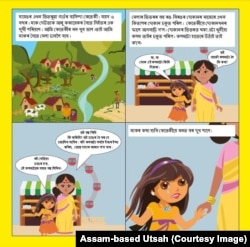
Since January of this year, thousands of school children in India’s northeastern state of Assam have pored over an illustrated story of how two young girls from a relief camp were lured by a man who told them of the good life they could lead in a big city, home to swanky buildings and flashy cars.
It sounded attractive to the poor youngsters who could only visualize a bleak life ahead.
Fortunately spotted by a policeman as they waited for the man at a railway station to head to the city, the story goes on to relate what their future could have been like when they were sold to work as poorly paid domestic employees, sex workers or laborers.
The comic in the Assamese language aims to raise awareness among children about trafficking rings that lure young girls and boys from villages into India’s booming cities with the promise of good jobs.
A comic that is being read in Assam highlights issues such as child trafficking.
The most vulnerable to human traffickers are states such as Assam, where a violent ethnic conflict has displaced many families, and the country’s poorer, underdeveloped states such as West Bengal, Telengana, and Andhra Pradesh.
As child rights campaigners stress prevention as key to addressing the problem, comic books have emerged as an effective tool to empower children to protect themselves in these areas. Children being sold accounted for nearly half of the human trafficking cases in India in 2015.
“There are more colors, more expressions, its an effective means of communication, especially for children,” says Miguel Queah at Assam-based non-profit Utsah, who wrote the story and helps organize reading sessions in vulnerable and displaced communities such as relief camps, children’s homes and government schools in Assam. “Children love reading the stories, discussing among their friends, we could see that response taking place” he says.
Orders to print more comics have gone out with the initial stock of 800 copies having run out and there is a proposal to incorporate it in school curriculums.
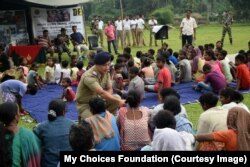
The non-profit My Choices Foundation began reaching out to rural communities a little over a year ago with its comic book, The Light of Safe Villages to educate children about threats such as trafficking and other social problems such as child marriage.
My Choices Foundation raises awareness among children about trafficking and other issues.
Hannah Norling who heads communications at the My Choices Foundation is confident that the colorful books and simple stories in local languages are effectively spreading the message of how traffickers trap young children. “We are in the right place,” she said.
It is distributed to students across more than 500 Indian villages.
She points out that while it is sometimes difficult to reach out to parents, who are busy working, children are more of a captive audience and the idea was to give them an illustrated book that could serve as a complete educational tool which they could share with their parents.
“We had to leave something behind that would be a long term reminder. If something happens a year from now, a physical frame of reference for them to revert back to 'OK now what do I do?” said Norling.
One of the stories in the comic is of a guardian girl on a mission to save others and another of a vigilant boy.
Growing awareness among children has made them more alert to threats from traffickers and some have reported to village council or others if they noticed a friend missing, according to Norling. She said that helped in the rescue of three girls in the past year who had left their village.
The comic book initiative is among several efforts to prevent trafficking in rural areas. One of them by Save the Children spreads the message in local communities through children who have been rescued.
India honored a woman on Wednesday when 21-year-old Anoyara Khatun, who was trafficked from West Bengal state, received the "Women Power" award from the president for stopping hundreds of other children from being forced into labor or married off.
Khatun was brought to Delhi when she was 12 years old and forced to work as a house maid, but managed to escape after six months. With the help of child rights advocates, she returned home and is part of a network of children’s groups in 80 villages where young people are taught about their rights.
Manab Ray at Save the Children in New Delhi points out that once trafficking has happened, there is little that can be done to help the victims, so the key is to stop it in villages. And at the heart of the effort to engage local communities are the children themselves. “Children we found are the best informers, in terms of knowing the issues, because they face it themselves, they can have the natural ability of identifying the traffickers and all,” said Ray.

Saturday, December 24, 2016

Ol Chiki Script (Santali language)


raghumurmu1.jpg

Pandit Raghunath Murmu
Born on 5th May,1905 and expired on 1st February, 1982
Pandit Raghunath Murmu is the inventor of Ol Chiki script. He was born in a village, called (Dahardih)Dandbose, on 5th May 1905 on the day of full moon in the district of Mayurbhanj, Orissa. After a brief stint in technical profession, he took up the job of teaching in Badomtolia high school. During this time, his interest was drawn into Santali literatures. Santali is a language with its own special characteristics, and has a literature which dates back to the beginning of the 15th century.  Naturally, he felt that Santals with their rich cultural heritage and tradition also need a separate script to preserve and promote their language, and therefore, he took up the work of inventing Ol Chiki script for writing Santali. The epoch making invention of Ol Chiki script was unveiled in 1925. In the novel Bidu Chandan, he has vividly described how god Bidu, and godess Chandan who appear on Earth as human being would have naturally invented the Ol Chiki script in order to communicate with each other using written Santali.  He wrote over 150 books covering a wide spectrum of subjects such as grammar, novels, drama, poetry, and story in Santali using Ol Chiki as a part of his extensive programme for culturally upgrading the Santal community. "Darege Dhan", "Sidhu-Kanhu", "Bidu Chandan" and "Kherwal Bir" are among the most acclaimed of his works. Pandit Raghunath Murmu is popularly known as GURU GOMKE among the Santals, a title that was conferred on him by the Mayurbhanj Adibasi Mahasabha. Besides the Govt of West Bengal and Orissa, several other organizations/associations including Orissa Sahitya Academy have honoured him in various ways and Hon D. Litt. was conferred on him by Ranchi University. The great thinker, philosopher, writer, and dramatist breathed his last breath on 1st February, 1982.

Why do we need Ol Chiki script ?
In earlier times, all Santali writings were in Bengali, Devanagari, or Roman script. Although there have been impressive number of works by foreigner and non-Santal writers on dictionary, grammar, collection of folklore etc., these works are mostly intended for research purposes. Roman script was in extensive use for writing Santali and several books in Santali have been published using Roman script.  But most of the creative literatures were written by the native speakers in Bengali or Devanagari script. The use of different scripts for writing Santali has hindered the development and utilization of Santali language. This, in turn, has effectively marred the progress of Santali language in several fields such as philosophy, history, religion, science, novel, prose, poetry etc. The problem of using different scripts for the same language necessitated the invention of a new script for Santali, and it finally led to the invention of Ol Chiki by Pandit Raghunath Murmu.

After the invention of Ol Chiki, a large number of books have been written by various authors in Santali using Ol Chiki script. Types of books include  (i) novels and short stories, (ii) poetries, songs, and religious sermons, (iii) books on Santal society, (iv) primary books for learning Ol Chiki, (v) books for learning primary mathematics, (vi) books on Santali grammars and related topics, and (vii) books on great tribal persons. Santali magazines in Ol Chiki are also being published regularly.

The problems with Indic Scripts:
The problems of correctly representing Santali sounds in Indic scripts, viz., Bengali, Devanagari & Oriya are explained here. Firstly, in Indic language, some phonetics like checked consonants / k', c', t', p'/ do not exist. If one attempts to suppress the inherent vowel of consonants /KA/, /CA/,  /TA/ &  /PA/ of any Indic script, it would only produce /k/, /c/, /t/ & /p/, respectively. There are no mechanisms to represent these unique Santali sounds. Secondly, there is a difficulty of representing the Santali vowels. Currently, the Santali language does use eight or nine vowels that can be short or long and nasalized, whereas the Indic scripts provide only six vowels. By modifying the vowels of Indic script using diacritic marks, the santali vowels can be represented to some extent, but when such vowels are used in the beginning of a word, they tend to approximate with closest vowels of the Indic script. Thirdly, there is no mechanism to represent the Glottal stop of Santali sounds which Santals use very frequently.

The problems with Roman Script:
Although the Roman script can nicely represent checked consonants, but it is not without deficiencies. The Roman script cannot distinguish between the short and long vowels. It is worth mentioning that the Santali long vowels are pronounced much longer than those of English, and other Indic languages. Another problem with Roman script is that it does not have any explicit mechanism to represent the Glottal stop. Therefore to retain the beauty, specialty, peculiarity & sweetness of Santali language, there is a need to use a script that can represent all sounds of the Santali language accurately and  is naturally appealing to all Santals, and it is definitely the Ol Chiki script that fulfils these requirements.

A Brief Introduction to Ol Chiki Script
The very basic information about Ol Chiki script is  provided  here. The intention of this tutorial is to provide information about the unique features of Ol Chiki writing system, which is often  misunderstood due to a lack of organised information about the script. Here, an attempt has been made to provide sufficient information about features and functions of various letters: vowels, consonants and diacritics. This tutorial is written by R. C. Hansdah and N. C. Murmu.
UPDATED ! on 10/08/2003

Introduction:This script is also known as Ol Cemet', Ol script, Ol ciki Script and also Ol. In Santali, Ol means writing and Cemet' means learning . So, Ol Cemet' means the learning of writing. Ol Cemet' is the title of the book, written by Pandit Raghunath Murmu for teaching the Ol Chiki to the beginners(primer). Ol Chiki is alphabetic, and does not share any of the syllabic properties of the other Indic scripts. It is used for writing Santali which belongs to the Munda group languages of the Austro-Asiatric family. One of the interesting feature of the Ol Chiki script is that it makes use of signs and symbols long familiar to the Santals. The very ingenuity in shaping the symbols of the letters and arranging the letters in the script has been greatly helpful in transmission of the script. A large number of words in the Santali language are derived from natural sounds. Letters of Ol Chiki script are also derived from the physical environment and what surrounds the people - hills, rivers, trees, birds, bees, plough, sickle - the list is endless . Norman Zide, an eminent linguist in his work (Zide, 1996) says, The shapes of the letters are not arbitrary, but reflect the names for the letters, which are words, usually the names of objects or actions representing conventionalized form in the pictorial shape of the characters. For example, the word At means earth and the shape of letter /AT/  derived from the round shape of earth. Similarly /UD/ means mushroom and so is the shape of the letter /UD/.
On commenting about Ol Chiki, Zide (1996)  observes, One ingenious - scientific and unique feature of Ol Cemet that certainly increases the efficiency of writing Santali is the deglottalizing ohot'(AHAD). This neatly preserves the morphophonemic relationship between the glottalized and the voiced equivalent: The former occurs in words at certain word-internal preconsonantal junctures, whereas the latter occurs prevocalically, but never morpheme-initially in these alterations. Thus /OK/ is the name of a letter that represents both /k'/ and /g/. Two further diacritics include a horizontal loop added at the top right of the character for aspiration of consonants, and a raised dot for vowel nasalization.


Santali language:
Santali language contains some phonetics which are generally not used in English and  neighbouring  Indian languages, and hence,  learning the correct pronunciations of Ol Chiki letters is very important. In fact, these pronunciations give a feeling of why Santali language  needs a separate script, specially the pronunciations of unreleased stops/ k', c', t', p' /, which are not found in English and other Indic languages. It is a momentary obstruction of the passage of air by the glottis and its sudden release, which creates a small explosion of air,  giving the consonant a hard sound. Another notable feature of Santali language is the presence of voiced and voiceless /h/. The  voiceless /h/ occurs frequently in Santali language. The occurance of nasals are also extremely regular and they have the phonological distinctions in even word final position.
Ol Chiki:
The Ol Chiki letters are arranged in a matrix of 6 by 5, in which the six letters in the first column of the matrix are vowels, and the rest  24 letters are consonants. However, the five letters of the third column represent dual consonants, and this, eventually, helps to represent 29 consonants with the help of diacritic Ahad. Ol Chiki gives 5 basic diacritics, and the combination of diacritics Mu Tudag and Gahla Tudag gives rise to another diacritic, called Mu-Gahla Tudag. The matrix of Ol Chiki letters are listed  with transliteration of alphabets, with pronounciation in brackets and their sounds in bracelets.


Ol Chiki Letters

ol_alphabets1.gif

The above table gives Ol Chiki letters,  their transliterations, their pronunciation and the corresponding phonetic alphabets(IPA). Phonetic alphabets are given to understand the correct pronunciations of Ol Chiki letters. Note: sometimes /AAW/ also approximates to /v/.


Diacritics:The diacritic Mu Tudag functions like Devnagari chandrabindu, and  it is used for nasalization of vowels. Gahla Tudag is used for generating additional vowels, and Rela is used for generating extra length in the vowels. Pharka is used as separator and Ahad has special properties, that will be discussed later.
 

ol_diacritic.gif
Vowels:
The important component of any writing system is the vowels, which are, indeed, responsible for producing words by joining the consonants. The description of vowel system of Ol Chiki script is given here. The Santali language has 9 vowels. The first six vowels are shown in first column of the Ol Chiki alphabets matrix. The next three vowels are generated juxtaposing the Gahla Tudag. But one of the vowel  generated by placing Gahla Tudag (/A/+ Gahla Tudag) has marginal phonemic status and rarely used. In Santali all vowels may be long or short and all vowels may be nasalized. The Santali diphthongs consists of two vowels; unlike English they never consist of a vowel and a semi-consonant. The below is that list of Santali language vowels along with their corresponding International phonetic alphabets.
ol_vowels1.gif

The first six are familiar vowels in English and many other Indian languages like Bengali, Hindi or Oriya. First vowel is equivalent to  /o/ of boil, boy , coy. The pronunciation of this vowel is similar to that of Bengali or Oriya first vowel which is also  the inherent vowel of Bengali/Oriya script.  /a/is pronounced as in /a/ of English word car. The pronunciation of /i/ is similar to that of /i/ in English word city or sit, and that of /u/ is similar to /u/ of put. The pronunciation of /e/ is similar to /e/ of English word get, and that of /o/ is more like /o/ of more. The remaining three vowels are discussed in the Gahla Tudag section.


Word Formation:
Ol Chiki writing system is alphabetic, and so,  it is better understood using Roman script. 
Normally, in Santali language, all words begin with either a vowel or single consonant. However, it is observed that inside a word, a combination of two consonants may occur, and, sometimes even three. But then one of these is a nasal. It is worth mentioning that, in Santali language, the occurrence of nasals is extremely regular.  These are even distinguishable in word final position.
Let us look at  some of the examples that illustrate how words can be formed using Ol Chiki letters. Suppose, one needs to construct a Santali word /am/, then just put the vowel /a/ followed by the consonant /m/. so, we write /a/ + /m/ =  a + m = /am/  which, in Santali,  means 'you'. Similarly, when we need to write  /ipil/, we write  /i/ + /p/ + /i/ + /l/ =    i+p+i+l = /ipil/  which, in Santali, means 'star'.  Given below is a list of examples which  would help to understand the mechanism of forming words using Ol Chiki  vowels and consonants. 

wordformation2.gif

Additonal consonants :
Apart from the consonants mentioned above, Santali language does use other aspirated consonants. An aspirated consonant is generated by juxtaposing /OH/, which functions more like English /h/,  immediately after another consonant. For example : /dh/  of Dhanbad, is generated using /EDD/ followed by /OH/.  It should be noted that, in Ol Chiki, it is  /OH/(and not /IH/) that is used to generate the aspirated consonants, and this is in contrast to the English language, where no such distinction is made. The consonant /OH/, when placed  immediately after the unaspirated consonants t/AT/, g/AG/, k/AAK/, j/AAJ/, c/UCH/, d/UD/, p/EP/, D/EDD/, t/OTT/, b/OB/ generates the  corresponding aspirated consonants.


Glottal stop:
Here is an example, where /OH/ is used along with /EN/  as in the word, /nhate/ which means 'this side'. This sound is a bit voiceless. This is a prolongation of /n/ along with /h/ sound, and  it is an example of glottal stop. A point to be noted here is that this glottal stop is  generated in combination of /IH/ with Ahad, but it is normally written in a shorter form using /OH/. Although there are few words in Santali language that use the glottal stop, but the use of such words are very frequent in Santali language. Here is a list of words where glottal stop is used.

glottal_stop2.gif
 
Mu Tudag:
This diacritic is used for the nasalization of vowels. As already mentioned that in Santali language, all vowels and diphthongs may be nasalized. It works in the same way as  the chandrabindu of Devnagari script. When it is placed immediately after a vowel,  the vowel gets nasalized. The example of nasalized vowels that are used in the words of Santali language are given below.
mu_tudag_ex1.gif
 
Gahla Tudag:
Gahla Tudag is used to generate the additional vowels from the following vowels, viz., open vowel /o/(first vowel), /a/, and /e/. The vowel /a/+/Gahla Tudag/ is the most frequently used vowel, and there is no exact English equivalent for the same. This is  a half open central vowel and  its pronunciation is approximately equivalent to that of /a/ in  ago. The vowel /e/+/Gahla Tudag/ is pronounced as in /a/ of English word gate and it is open /e/(half open front vowel). But the pronunciation of the vowel  /o/+/Gahla Tudag/ is very nearly the same as that of the original vowel, and it occurs in a few words only.
  
 
Mu-Gahla Tudag:
The  Mu-Gahla Tudag indicates that the new vowel generated by the Gahla Tudag is nasalized.
mu_gahla_tudag.gif
 
Rela:
In Santali language, all vowels may be short or longs and it is Rela that is used to lengthen the pronunciation of vowels. For example, in the pair of words /hit/ and /heat/ (or /bit/ and /beat/ ) in English, the former uses a short vowel , but  the later uses a long vowel. In case of Ol Chiki, the long vowels are pronounced much longer than those of English, and a long vowel corresponding to a vowel  is indicated by immediately following the vowel  with the diacritic Rela. The Rela is extensively used in the adverb of Santali language. Here is a list of words that use the rela and their pronunciations and meanings.
rela_ex.gif
 
Ahad:
In Ol Chiki, the letters, /AG/,  /AAJ/,  /UD/, and  /OB/ are semi-consonants. These semi-consonants become consonants (voiced equivalents), when they are immediately followed by a vowel or Ahad. This generates dual sounds from these semi-consonants depending on whether they are immediately followed by a vowel/Ahad or not. This is a feature unique to Ol Chiki, which is not observed in any other writing system.
Take the  example of  /AG/: it produces two sounds, viz.,  /k'/ and /g/.  The use of  /k'/ is in words like /amak'/your/ or /senok'/go/. The /k'/ is not fully released in these circumstances. The pronunciation of this consonant is a bit unique to Santals, and it is in-between /k/ and /g/. It starts with /k/ and glides towards /g/. Similar is the case with /AAJ/, which gives /c'/ and /j/ (Here /c/ is unreleased /ch/ of church ). Similarly, /UD/ gives /t'/ and /d/, and /OB/ gives /p'/ and /b/.
 
Whenever a semi-consonant occurs at the end of a word, and the word is naturally extended for a different use using a vowel or Ahad, it is always the corresponding consonant as given above that appears in the new word. What it means is that /k'/ will always get extended to /g/, and never to /k/, and so on.  This behaviour of semi-consonants normally occurs in verb formations, and hence, this transformation is very widely used in Santali language. As an example, consider the following pair of sentences: /Uniy rak' kek'a/He wept/ and  /Uniy raga/He will weep/.  In this example, /kek'a/ in the first sentence  gets replaced by /a/ in the second sentence, and therefore, /k'/ in /rak'/ gets extended to /g/ in /raga/. Exmaples of pairs of sentences using other semi-consonants are as follows: /Uni toway hedec' kek'a/He boiled milk/ and /Uni toway hedeja/He will boil milk/, /Uniy ut' kek'a/He swallowed/ and /Uniy uda/He will swallow/,  and /Uniy up' kek'a/He poured/ and /Uniy uba/He will pour/.  An example of a  pair of words that can show this behaviour  is  /rakap'/lift(intransitive verb)/ and /rakab/lift(transitive verb)/.   This is the reason why each of the Ol Chiki  letters /AG/,  /AAJ/,  /UD/, and  /OB/ has been used to represent the dual sounds as given above, and   because of  this special behaviour of these letters in word formation, they have been termed as "semi-consonants". However, a better name can be sought if it is deemed so.

Pharka:
The diacritic Pharka  is used very frequently in Santali writings and works as separator in two ways. First, it is used to separate two consonants of similar paired words as in /sujh-bujh/understanding/. Second, it is used to separate a consonant from the following vowel. It is generally used to prevent the semi-consonants from becoming full consonants and these cases occur in a large number of  verb formations such as  /menak'-a/have/Verb/,  /hijuk'-a/come/Verb/ etc. Also, there is another situation, where nasal consonant  /ANG/,  is separated by Pharka from the following vowel.


Punctuation marks:
The main punctuation mark used is the single vertical line "|",  and it marks the  end of a sentence. There are  other familiar punctuation marks which are also used in Santali language. The names of punctuation marks as given in the grammar book Ranal written by Pandit Raghunath Murmu are as given in the following table.

puntuations2.gif

The hand writing of Ol Chiki letters:
The Ol Chiki gives hand writing letters for fast writing. It is called  /usA.ra ol/. The hand writing letters consist of all letters which are vowels and consonants,  and the letters which are formed in combination of /IH/ and  four semi-consonants , /AG/, /AAJ/, /UD/, /OB/ with Ahad. In normal writing, the combination of  /IH/ with Ahad is not found, as  it is generally written in a shorter form that is /OH/.
 

ol_usara.gif

Digits:
Ol Chiki uses decimal system, and the symbol for  basic digits  0-9 are as follows:

ol_digits.jpg

Origin of Ol Chiki letters:
The great novelties and usages in Santali language are as a result of the   natural derivation of the forms for words, where, sounds generating out of actions or movements from animated or unanimated objects or sounds associated with living being and their corresponding words, are robustly approximated. Therefore, Pandit Raghunath Murmu tried to infuse this concept of natural formation of Santali words into Ol Chiki. When Pandit Raghunath Murmu devised the script, he carefully choose the shapes of the scripts from the nature, the surroundings which is long familiar to the Santals, and is close to them. The Santals form a community which has wonderful relationship with nature, and they respect it very well. Santal mythology gives many stories and songs that depict very importance of respecting nature and sense of preserving it. The selection of shapes for Ol Chiki letters is directly based on the shapes of objects or actions  which the sounds for the letters represent, or with which the sounds for the letters are in some way associated. Naturally, the sources for the shapes of letters were fire, soil, water, air and sky- an environment that surrounds them. This is an indigenous concept and has multiple objectives. It would greatly help them to remember the letters easily, since they are familiar with the shapes and sounds that  can be  easily retrieved from the corresponding image from the nature. It can be observed that the shapes of most of the letters are either oval or round. This is due to the nature of origin of letters, whose shapes are often derived from the shape of an object or action of natural environment. For example, the word /AT/ means Earth and the shape of letter /AT/ is derived from the round shape of Earth. Similarly /UD/ means mushroom and so looks the shape of the letter /UD/. Here is the list of meaning of all letters given in Ol Chiki writing system.
/A/     : The shape of  burning fire.
/AT/   : The shape of Earth.
/AG/  : The shape of mouth during vomiting which produces the
            same  sound as the name of the letter.
/ANG/: Blowing air.
/AL/  : Writing.
/AA/  : The shape of  working in the field with a spade.
/AAK/: Sound of Swan or shape of a bird.
/AAJ/ : The shape of a person pointing towards a third person with
            right hand(saying he).
/AAM/: The shape of a person pointing towards a second
           person with left hand(saying you).
/AAW/: Opening lips.
/I/     : Bending tree .
/IS/   : The shape of plough.
/IH/   : The shape of hand ups.
/INY/ : The shape of a person pointing towards himself or herself with
            left hand.
/IR/   : The shape of a sickle used for cutting or reaping(IR).
/U/    : The shape of a vessel used for preparing food.
/UCH/: The shape of a peak of  a mountain which is usually high.
/UD/  :  The shape of mushroom.
/UNN/: The picture of a flying bee which makes this sound.
/UY/  : The shape of a man bending towards ground to cut something.
/ E/   : Overflowing rivers changing course.
/EP/  : A person receiving with both hands.
/EDD/: The shape of a man with two legs stretching towards his 
           chest and mouth.
/EN/  : The picture of thrashing grains with two legs.
/ERR/: A picture of a path that turns to avoid an obstruction or a
          danger.
/O/   : The shape of mouth when sounding this.
/OTT/: The hump of a camel.
/OB/ : Curly hair.
/OV/ : Nasalized.
/OH/ : The figure of a man throwing something with one  hand.


For sample text, please click any Disom Khobor issue.
 
(Source: Most of the information  is extracted from  the  proposal for encoding Ol Chiki Script in UCS  prepared by the authors. Copyrights©2002, Authors. All rights reserved.)


Wednesday, December 14, 2016

बचपन की यादें-01

कभी कभी मैं अपने बचपन की यादें को छत पर .., पुरानी किताबों में .. या फिर किसी पुराने फोटो में टटोलता रहता हूँ.

ऐसे ही लिखते हुए अचानक एक किताब का नाम ज़हन में आ गया. नाम ही क्या किताब का कवर पेज से लेकर आख़िरी पन्ना तक याद आ गया.

"मनमौजी मामा जी " यह किताब मुझे मेरे एक दोस्त वसीम ने स्कूल के दिनों में गिफ्ट की थी.

क्यों गिफ्ट की थी याद नहीं.., ज़रूर इसके पीछे कॉमिक्स की अदला-बदली की कोई बड़ी डील रही होगी.


वसीम तुम कुछ ज्यादह ही जल्दी चले गए इस दुनियां को अलविदा कहकर.., आखिर ऐसी भी क्या जल्दी थी.

मेरी किताबों के पन्नों में आज भी जहाँ तहां तुम्हारी यादें छुपी ढूकी मुझे मिल जाती हैं.

दिल तो चाहता है कि बहुत कुछ लिखूं तुम्हारे बारे में..,

लेकिन कुछ यादों के साथ जलने में जो मज़ा है वह हर्फो के उकेरने में नहीं आता...-तुम्हारा दोस्त.


                                                                              http://www.jacketflap.com/profile.asp?member=IraSaxena

Friday, January 22, 2016

ek prem kahani.

लोगो को पसंद आ रही है  'H2SO4 एक प्रेम कहानी '

चाहो जहाँ पहुचेगी वहां...

दोस्तों आप shimply.com  के 'H2SO4 एक प्रेम कहानी'  India, USA, UK, Canada, UAE, Australia, New Zealand सहित 200 देशों से, आर्डर करके मंगा सकतेहैं.

फुर्सत के पल

 फ्रेंच लेखक व्योमा और एस. ऍम .रज़ा के साथ फुर्सत के कुछ पल
  फ्रेंच लेखक व्योमा , सुमित नौटियाल और एस. ऍम .रज़ा के साथ फुर्सत के कुछ पल
  फ्रेंच लेखक व्योमा  के साथ.
 एस. ऍम .रज़ा और व्योमा

विमोचन

(पुस्तक वमोचन के अवसर पर लेखक दोस्तों के साथ. )

विश्व पुस्तक मेला -2016 दिल्ली ,झलकिया-01

अंजुमन प्रकाशन  के स्टाल पर सुमित के साथ 

 अंजुमन प्रकाशन  के स्टाल पर सुमित के साथ 

 'शर्तिया इश्क ' के लेखक शकील समर और मंजू यादव के साथ

दोस्तों के साथ 

Thursday, October 15, 2015

H2SO4-Ek Prem Kahani. Teaser.


"यहाँ हर चेहरे की  अपनी एक कहानी है. मेरे हाथ थक चुके हैं लिखते लिखते लेकिन यह कहानियां ख़त्म होने का नाम नहीं लेती हैं. 
न जाने कितनी रातें मैंने बेचैनियों में गुज़ारी हैं. 
यह घनी अँधेरी रात न जाने कब खत्म होगी. 
यकीन नहीं होता है कि मैं इनको लिख रहा हूँ , या यह मेरी जिंदगी को लिख रहीं हैं." 


H2SO4-Ek Prem Kahani.
Teaser.
Concept- Usman Khan
Editing- Sumit Nautiyal

Thursday, October 1, 2015

Thursday, September 10, 2015

Saturday, September 5, 2015

Cover Page

थंगा के साथ कवर पेज के लिए विचार विमर्श 

Demo Cover page.

एक डेमो कवर पेज जो फाइनल होते होते रह गया....

Nav Viksit Rashtra Nirman